|
|
||
|---|---|---|
|
|
||
|
|
||
1756 |
On January 27, a boy is born to Anna Maria Mozart, née
Pertl, and her husband Leopold, in Salzburg (Saltzbourg)*, a city in the
center of Austria, part of the large Hapsburg empire, and under the
administration of a prince-archbishop. The next day, the little boy is
christened Joannes Chrysostomos Wolfgangus Theophilus Mozart. In later life,
he will sign as Wolfgang Amadé Mozart. He is the seventh and will be the
last child of the Mozarts, but only the second one to survive infancy. His
sister Maria Anna, or Nannerl, is five years older. The father is a musician
in the court orchestra and will publish, in July of that year, a textbook on
the art of playing the violin, Versuch einer gründlichen Violinschule,
which is going to appear in several editions and translations and is to earn
him praise and distinction throughout Europe.
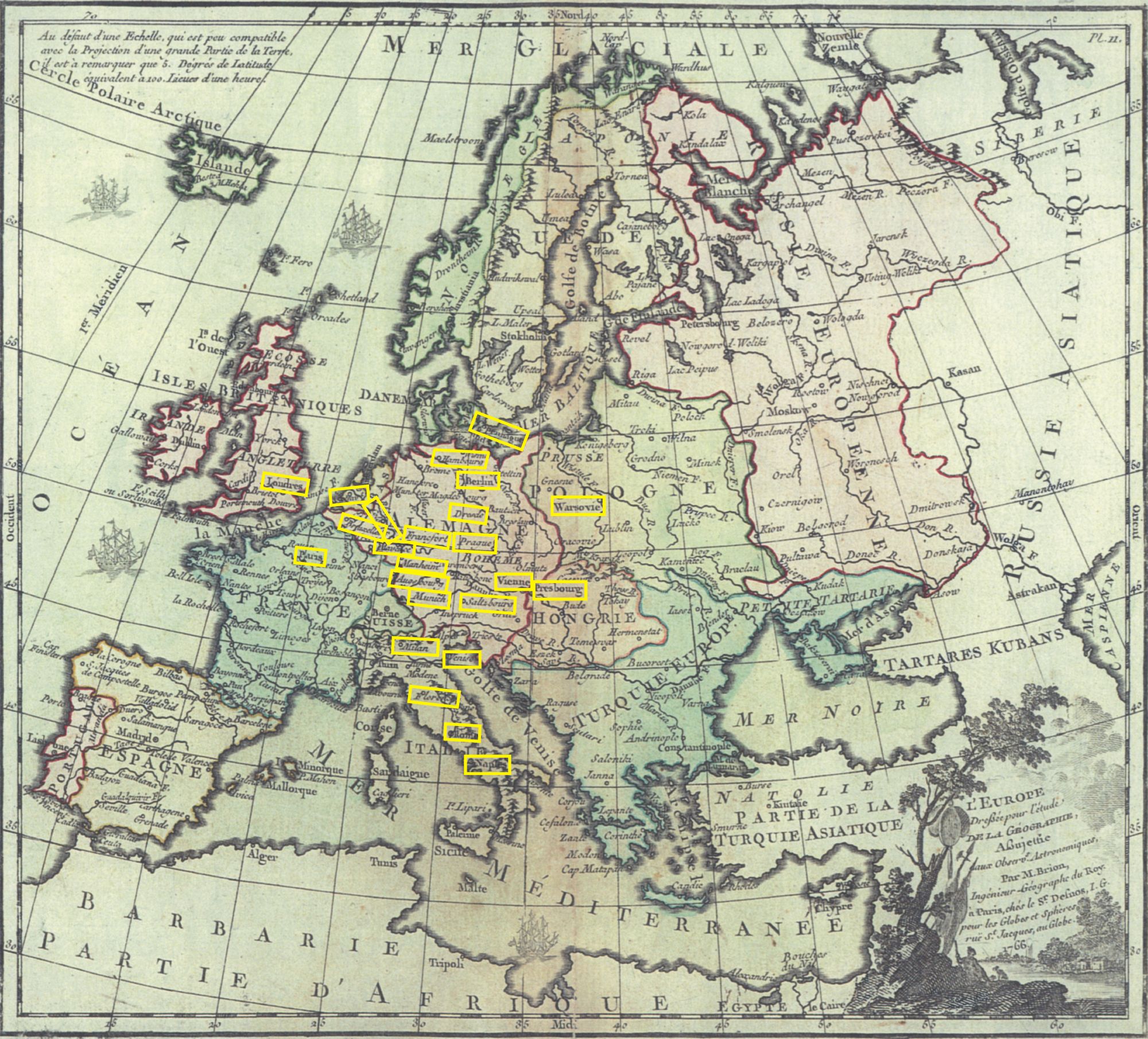
*The cities marked in color appear on the contemporary map of Europe under the names in brackets. The year is marked by the beginning of the Seven-Years War between Prussia and the allied forces of Austria and France. |
 |
1758 |
Leopold Mozart gives Nannerl her first piano lessons and discovers that Wolfgang takes great joy in tinkling the keys. | |
1760 |
The father starts collecting some easy piano exercises in a notebook, Pour le Clavecin, for Nannerl, mainly with pieces by contemporary composers. Wolfgang has managed to learn how to read music; he already plays from the noteboook and demonstrates an astonishing talent. | |
1761 |
Wolfgang’s first compositions, an Andante for piano (KV
1a**), an Allegro for piano (KV 1b), an Allegro (KV 1c) and a charming
little Minuet (KV 1d), are entered in the notebook. ** KV refers to the Köchel-Verzeichnis (6th ed.; Giegling, Weinman, Sievers, eds., Wiesbaden 1964), a chronological index of Mozart’s works. |
|
1762 |
The ambitious father takes his two Wunderkinder on
their first concert tour in January, to play before the Prince-Elector of
Bavaria in Munich. On October 1, Wolfgang Amadeus gives his first public performance in Linz, about 100 km northeast of Salzburg. His sensational success is brought to the attention of Archduke Joseph, the son of Empress Maria Theresia, who promptly invites him to play at the Hapsburg palace of Schönbrunn in Vienna, on October 13. From this day on, the list of appearances of the two child prodigies in the mansions of nobility and in public concert halls grows steadily. The father is careful with the considerable amounts of money coming in, and although he makes it his primary objective to see to the children’s careers, he is cautious enough to keep his position as newly promoted vice-Konzertmeister, or assistant conductor, of the Salzburg court orchestra, leading 38 musicians in this very respectable position. Little Wolfgang gets his permanent set of teeth and goes through the typical childhood diseases. In late October, he falls ill with a rash that is now thought to have been Erythema nodosum, produces painful nodules on the skin and probably expresses an underlying chronic infectious disease. He has recovered by the end of November. Towards the end of December, brief concert tours to Presbourg in Hungary and then to Vienna again. The Mozarts now travel in style, with a manservant and in their own carriage heated by a little charcoal stove. |
|
1763 |
The Seven-Years War comes to an end. In June, the family
embarks on a trip through Western Europe following a number of invitations.
A week in Munich is very productive. Nannerl in particular gets rave reviews
for her recitals. Their success repeats itself everywhere they go, in
Schwetzingen, Mannheim (Manheim),
Mainz (Mayence) and
Frankfurt (Francfort),
among a number of other places, then in Cologne and
Brussels (Bruxelles),
which is at the time the capital of the Spanish Netherlands and part of the
empire of the Hapsburg dynasty. The Mozarts reach Paris on the 18th of November; they are staying in the mansion of the Bavarian ambassador to France. In December, they are granted an audience with King Louis XV and they also meet Madame la Marquise de Pompadour, his mistress. |
|
1764 |
Wolfgang’s first four Sonatas for piano and violin (KV 6 to
9) are published in February. The childrens’ numerous performances at the
court and in public earn them princely honoraria. The family leaves Paris for London, now accompanied by two servants, on April 10. Preceded by their budding international reputation, the children play before King George III already a week after their arrival, then again in May and October. Their stay is hectic: Nannerl and Wolfgang give a great number of public recitals, Wolfgang composes most of the pieces contained in his London Chelsea Notebook (KV 15). The children have to show themselves at numerous functions and they still find the time to attend operas and concert performances, all this in spite of several illnesses described as catarrhs and with the symptoms of what we now call the flu. In November, Wolfgang Amadeus makes the acquaintance of Johann Christian Bach, the youngest son of Johann Sebastian, who resides permanently in London and has had much success as the composer of a series of operas. Nannerl writes in her diary how Johann Christian held the eight-year old Wolfgang between his knees at the keyboard and how they took turns improvising to everyone’s delight. |
|
1765 |
The Sonatas for piano, violin (or flute) and violoncello,
KV 10 through 15, are printed, dedicated to Queen Sophie Charlotte. Leopold
Mozart repeatedly places an advertisement in a London newspaper inviting the
public to come to their house and hear the “young marvels” play, at any day
of the week between 1 and 3 o’clock in the afternoon, for a fee of 5
shillings per person. Wolfgang arranges three piano sonatas by Johann Christian Bach as Concertos for piano, 2 violins and bass (KV 107). The Mozarts finally leave London for the continent on the 24th of July, after more than a year, and Köchel’s chronological index of Wolfgang’s works arrives at KV 16. In September, now in Den Haag (Hay), Nannerl becomes gravely ill with what is called abdominal typhus, suffering from diarrhea, fever and the chills; she is given the last rites in October but recovers slowly thereafter. The same disease ties Wolfgang to the bed for four weeks starting in mid-November. He is down to skin and bones when he has his health again. |
|
1766 |
The Mozarts are touring The Netherlands during the months
of January through April and give performances in most of the major cities.
These often take on the character of circus acts: Nannerl and Wolfgang play
unknown pieces on sight, they improvise on themes given from the audience or
play on a keyboard covered with a piece of cloth. Wolfgang possesses the
gift of absolute pitch, that is, he can recognize and name any sound’s
position on an absolute frequency scale, and this is used to entertain the
audience and enhance the little boy’s fame. He enjoys Dutch folk music and writes variations on some popular songs (e.g. KV 24 and 25). The Dutch Royal Court commissions him to write sonatas for piano and violin (KV 26-31) which he duly completes in that same year. The children’s schooling is in the hands of their father who carries out this duty with interest, love and devotion. Particularly Wolfgang takes easily to mathematics and enjoys playing with words and expressions in the languages they encounter. By early May the family is back in Paris, right back in the active musical scene of that city. They leave again in July, travelling through southern France into Switzerland. In Lausanne, the Mozarts stay with the influential Prince Ludwig Eugen of Württemberg who is a very good flutist and great admirer of Wolfgang’s. A professor at the Medical Academy of Lausanne, Auguste Tissot, publishes a paper in which he seeks to explain the particularities of Wolfgang’s genius and their physical elements. In Munich, in the cold of November, Wolfgang complains about a type of rheumatic pain in the joints. They arrive in Salzburg on November 26, after having been on tour through Europe for three-and-one-half years. |
|
1767 |
Premiere performance of Part I of the spiritual drama The
Obligation of the First and Foremost Commandment (KV 35) composed by the
now 11-year old Wolfgang (Parts II and III are written by Michael Haydn and
Anton Adlgasser, respectively). The Archbishop of Salzburg, Sigismund von Schrattenbach, is said to have locked up Wolfgang Amadeus for a week in order to test his “suspiciously great talent for writing music”, and to have ordered him to compose a cantata for Good Friday. This Grabmusik (KV 42) is then given on April 17, in the Salzburg Cathedral. Wolfgang’s first opera Apollo et Hyacinthus has its premiere performance at the University of Salzburg. In September, the Mozart family leaves Salzburg for Vienna, to take part in the festivities around the wedding of Archduchess Maria Josepha with Ferdinand IV, the King of Naples, but the young bride succumbs to a vicious smallpox epidemic. The Mozarts try to avoid being infected by moving out of the city. By the end of October, Wolfgang has contracted the disease just the same, and a week later Nannerl comes down with it also. Fortunately, they both escape death. |
|
1768 |
Return to Vienna in January. Reception at the Court of the
recently widowed Empress Maria Theresia. Her son, the Emperor Franz Joseph
II., asks Wolfgang if he wanted to write an opera. Wolfgang follows the
suggestion and completes La finta semplice (The Pretended Simpleton,
KV 51) in July but a performance is prevented by intrigues at the court.
WA’s singspiel Bastien und Bastienne (KV 50) is performed in a
private theater owned by Dr. Franz Mesmer who has come to fame and riches
through the practice of bringing his patients into an altered state of mind
by a form of hypnotism (“mesmerization”). Wolfgang conducts his Missa solemnis (KV 139) or Waisenhausmesse at the consecration of the Waisenhauskirche, or Church for the Orphans, in December. Departure for Salzburg. |
|
1769 |
Wolfgang Amadeus writes the masses KV 65 and 66, the latter
nicknamed Domenicus-Messe for his friend Cajetan Hagenauer at the
occasion of his entering the priesthood as father Domenicus. Premiere
performance of La finta semplice (KV 51) in
Salzburg. Finally, in November, Wolfgang obtains the regular position his father has been trying to get for him, as Third concert master of the Salzburg court orchestra, albeit a honorific position without remuneration. The Archbishop, his superior, gives Leopold a considerable amount of money at Wolfgang’s nomination, to be used for a study trip to Italy. Father and son leave on December 19, this time not accompanied by the mother or the sister. On Christmas Day, Wolfgang plays the organ in the church of the small town of Rovereto, Italy, North of Verona. |
|
1770 |
The letters of recommendation Leopold has collected from
everyone of name help them to get in contact with everyone of importance
wherever they go. Letters of credit provide the finances for travelling, the
letters of recommendation also serve as collateral. Wolfgang is received with the highest honors, and accounts of his presentations and recitals, the reviews, the honors and the income he collects are found in some detail in Leopold Mozart’s regular letters to his wife as well as to his friend and patron Lorenz Hagenauer. They stay in Milan for the entire month of February. Wolfgang’s output of new compositions is quite astonishing given the societal obligations he has to meet. In the first three months of this year, he writes, among others (!), three symphonies (KV 215, 217, and 218), one motet (KV 143), and his first string quartet (KV 80). Neither his musical inventiveness nor his energy are exhausted at all by this: he gives several recitals during which he presents his freshly written works and improvises, and he likes to play with the many musicians of renown who come to see him. Wolfgang Amadeus is commissioned to write an opera for the Milan theater’s next season, and this is to become Mitridate, Rè di Ponto (Mitridathes, King of Pontus). They continue their voyage in March; further stations are Piacenza, Parma, Bologna, Florence, Siena, Orvieto and Viterbo, on the way to Rome. In Bologna, Wolfgang demonstrates his talents to the famous music theoretician Padre Giovanni Battista Martini by composing several fugues on given themes. On April 11, Leopold and Wolfgang Amadeus enter the Eternal City. That same afternoon, they hear Gregorio Allegri’s Miserere in the Sistine Chapel, and the music so impresses WA that he writes down the entire 9-voice score from memory in the evening. For this extraordinary accomplishment, Pope Clement XIV awards him with the highest rank of the Order of the Golden Spur. It appears that Wolfgang met with, and performed for, just about everyone of standing in Rome. The father prepares the continuation of the trip with know-how, intelligence and zeal, and with a certain measure of greed (it appears). There is no indication that he overestimates, overextends, or exhausts his son’s musical, mental or physical capabilities. Leopold and Wolfgang leave Rome for Naples on May 8. The stay there until the end of June, and are as usual engaged in a whirlwind of activities. At least they also find the time to visit Pozzuoli, Pompeii and other tourist sites, guided by a high government official. After a short interval in Rome, the voyage continues to Bologna. There, Wolfgang passes a written exam to become a member of the distinguished Accademia Filarmonica. At the end of July, he receives the libretto for the new opera Mitridate, Rè di Ponto. Between the months of October and December, back in Milan, WA meets the artists who are to sing the major parts of his new opera, adapts the music he composes to their abilities, and rehearses the opera (KV 87) to its premier performance in the Teatro Regio Ducal on December 26. |
|
1771 |
The next major station on the Mozarts’ voyage through Italy
is Venice (Venise) where Wolfgang receives, from Milan, another commission
to write an opera. Return to Salzburg at the end of March, after more than one year’s absence. Empress Maria Theresia requests that Wolfgang compose an opera for the wedding ceremony of her son Ferdinand. For this occasion, father and son travel again to Milan in August. The libretto for the opera is sent them only at the end of the month, but Wolfgang Amadeus is nevertheless able to complete the opera Ascanio in Alba (KV 111) by the date of the wedding ceremony, October 15. They are home in Salzburg in time for Christmas. |
|
1772 |
Wolfgang is now 16 years old, no longer a Wunderkind
but an established and admired composer and performer. The new
Prince-Archbishop of Salzburg is Joseph Franz Count Colloredo, elected as
the successor of Archbishop Count Schrattenbach who has passed away. He
decrees in August that Wolfgang is to receive a salary of 150 gulden per
year as Third concert master. Leopold and Wolfgang leave on their third voyage to Italy in October, to fulfill the engagement of writing an opera for the theater in Milan. Lucio Silla (KV 135) is completed shortly after Christmas, after many delays and the resulting stress mainly because the star performers often do not show up or are indisposed. |
|
1773 |
Return to Salzburg in early March. In July, they are on the road again, this time to Vienna where, as they hope, Wolfgang will find a position at the Imperial Court. Wolfgang is introduced to the Glasharmonica, an instrument invented by the American Benjamin Franklin. It is based on the sound emitted when the a drinking glas is set in vibration with a wetted finger passing around its rim. Franklin arranged a number of glasses of different sizes stacked on a common horizontal axle such that they could be rotated all at once by a foot pedal mechanism, all within reach of the player. The “magnetizer” physician Franz Anton Mesmer shows Wolfgang how to play it. WA is captivated by the strange sound and will write an Adagio for it (KV 356) shortly before his death in 1791. WAM composes his first piano concerto (KV 175); the earlier piano concertos are predominantly transcriptions or arrangements of other composers’ works. |
|
1774 |
A relatively uneventful year for Wolfgang Amadeus. His new opera La finta giardiniera (The Pretended Gardener Girl) is in rehearsal. | |
1775 |
Premiere performance of La finta giardiniera (KV
196) in the Salvator-Theater in
Munich, before the Bavarian Elector
Maximilian III and a distinguished audience. Wolfgang receives enthusiastic
applause, congratulations and honors but the opera is finally performed only
three times. He has already completed his next opera, Il Rè pastore (The Shepherd King, KV 208) which is performed for the first time on April 23, in Salzburg. Further notable compositions from this time are WAM’s first violin concerto (KV 207) and the Serenade KV 104, a Finalmusik written for the graduation ceremony of the students at the University of Salzburg. |
|
1776 |
In early spring, Wolfgang composes the Concerto for three
pianos KV 242, dedicated to the wife of Count Lodron and called Lodron
Concerto since then, shortly afterwards the Piano concerto KV 246 (Lützow
Concerto) for the Countess of that name. On Easter Sunday, the mass
celebrated in Salzburg Cathedral is accompanied by Mozart’s music (KV 220).
The list of Wolfgang’s accomplishments during this year is long and impressive. Famous works are written and played, as e.g. the Haffner-Serenade, KV 250, and the offertorium Misericordias Domini, KV 222 (a psalm sung in mass between Credo and Sanctus). |
|
1777 |
The Mozarts’ relation to Archbishop Colloredo, their
employer, is deteriorating. Wolfgang Amadeus is now 21 years of age, an
international celebrity, has created more than 200 works of timeless art, is
recognized for his talent by his peers, has widely traveled, and he is
fluent in at least three modern languages and well versed in Latin. His
music is, however, not quite appreciated by Colloredo who prefers the
Italian style. Wolfgang and his mother Anna Maria leave Salzburg for Paris on September 23; father Leopold has not obtained the Archbishop’s permission to quit his orchestra position and travel with them. The objective of this trip is, as before, to find a permanent position somewhere with a regular and adequate salary. The quest turns out to be is a failure: no vacancies for a position corresponding to Wolfgang’s status either in Munich, Augsburg (Augsbourg) or Mannheim. Travelling is expensive, so Wolfgang is reduced to taking students to play the flute, the double bass, the piano, or the violin, in Mannheim even to pay the rent. Searching for someone who could copy his works for a presentation portfolio, Wolfgang makes the acquaintance of Fridolin Weber, a musician at the Mannheim Court Theater, and promptly falls in love with his daughter Aloysia. She is sixteen years old and her beautiful voice should, he believes, be trained in Italy. And he, Wolfgang, would like to accompany the Webers, as he writes his father. Leopold is dismayed and rejects the idea. He sternly admonishes his son that only Paris could further his career, and he encloses a list of persons of influence he should contact there. He is also concerned that his wife and son stay out of the reaches of the so-called Bavarian War of Succession which pits Austria against Russia, among other countries. |
|
1778 |
Wolfgang Amadeus has become friends with Concert master
Christian Cannabich in Mannheim who arranges for several concerts in which
the members of the famous court orchestra perform near exclusively Mozart’s
works. Wolfgang and his mother leave Mannheim for Paris on March 14 and arrive there on March 23. There are lots of things for him to do but none of them bring much money. He is offered the position of organist in Versailles but does not accept it because of the relatively low salary. He is writing again, beautiful works like the Sinfonia concertante (KV 297), the Paris Symphony, after the delays in Mannheim caused by his love pains. His mother Anna Maria becomes very ill, suffers a high temperature, loses her hearing and then lapses into unconsciousness. She dies on July 3. Wolfgang leaves Paris on September 26, after receiving a letter from his father informing him that Archbishop Colloredo has agreed to re-instate him in his position as Third Konzertmeister at a salary of 500 gulden per year. At about the same time Aloysia Weber is hired in Munich as a soprano and receives 600 gulden yearly. WA stays with the Webers on his way home but Aloysia rejects his advances. His sister describes him as a slight man carrying a large head, with beautiful and expressive eyes. He keeps postponing the return to Salzburg and writes his father how he dislikes the people there and their way of life. He asks his cousin (“das Bäsle”) Maria Anna Thekla Mozart to come with him to Salzburg, to calm his father and to help him get used to the place again. |
|
1779 |
Wolfgang Amadeus is back in
Salzburg at some time in late
January. He is appointed organist at the Salzburg Cathedral.
In March, he completes the Coronation Mass (KV 317). Fridolin Weber, the father of Aloysia, dies in Vienna after suffering a stroke. |
|
1780 |
WA is granted a leave of absence of six weeks by the archbishop, starting in November, to travel to Munich in order to complete his new opera Idomeneo, Rè di Creta (Idomeneo, King of Creta, KV 366) in direct contact with the cast, and to see to its first performance. | |
1781 |
Wolfgang extends, without permission, his stay in
Munich beyond the premiere performance of Idomeneo in January but is ordered
to come to Vienna where the Archbishop wants to show off his musicians
before the emperor. Mozart resents being treated like a servant and
expresses his discontent in the strongest terms in letters to his father. He
is particularly unhappy that he is forbidden to arrange for performances or
recitals on his own, and that he is thus deprived of an important source of
additional income. He writes that he has been kicked in the behind by a
Count Arco, some underling, after his request for a longer study trip was
denied and he asked to be given permission to quit the archbishop’s employ. Wolfgang gives a few concerts in Vienna, at least one before Emperor Joseph II. In May, he moves into a room in the house of Cäcilia Weber, the widowed mother of Aloysia, and stays there inspite of the fact that the archbishop has ordered him to return to Salzburg, and against the express wishes of his father. By this action, his employment in Salzburg is in effect terminated. He hopes for the Imperial Court to give him a commission for an opera; he receives the text for the new opera “on a turkish sujet” in late July. Mozart’s six Sonatas for piano and violin (KV 296 and 376 to 380) are published in Vienna. In December, Mucio Clementi and Wolfgang Amadeus Mozart have a friendly piano competition in the residence of Emperor Joseph II. Years later, the emperor will still speak with delight of this event. Constanze Weber, born 1763 as the third daughter of Fridolin and Cäcilia, and Wolfgang Amadeus are in love. |
|
1782 |
Die Entführung aus dem Serail (The Abduction from
the Seraglio), KV 384, is given for the first time on July 16, in the Wiener
Burgtheater; it is a great success. The composer Christoph Willibald Gluck
sends him his congratulations. In the opera’s story are a number of
parallels to Mozart’s courtship of Constanze and her flight from under her
mother’s strict regime. Wolfgang meets the author Lorenzo da Ponte who has just been appointed Court poet. Constanze and Wolfgang Amadeus Mozart marry on August 3 in St. Stephen’s Cathedral in Vienna. |
|
1783 |
The newlyweds move several times; they are spending money
beyond their means and are indebted to several patrons of the arts. Wolfgang
is busy giving recitals of his works and improvisations in so-called
“academies” arranged by himself or by other musicians. His latest opera, The Abduction from the Seraglio, is given in a number of cities in
Germany, always to enthusiastic acclaim. Raimund Leopold Mozart is born to Constanze and Wolfgang on June 17, their first child. Constanze asserts that Wolfgang wrote the String quartet KV 421 during the delivery. His opera Lo sposo deluso (The disappointed Bridegroom), KV 430, is composed in that summer but will remain uncompleted. The Mozarts go on a tour to visit relatives and leave their one-month old son in the care of a nurse. They lose their child in August to a severe intestinal disorder and find out about his death only on their return to Vienna in November. Wolfgang conducts his Mass in C minor (KV 427) in Salzburg. Constanze sings one of the two soprano parts. |
|
1784 |
During the first three months of this year, Mozart gives at
least a dozen recitals, mostly of his own works, some of them performances
in series to which one can subscribe. 174 subscriptions are sold, as he
proudly reports to his father. He completes the Woodwind quintet (KV 452)
which he considers the best music he has ever written. He is very active:
the list of compositions for this year is long.
Constanze and Wolfgang’s second son Carl Thomas is born on the 21st of September. The Abduction from the Seraglio is performed in a great number of major European cities, and finally, in November, also in Salzburg. Even Count Colloredo, Wolfgang’s former employer, gives it faint praise. Wolfgang becomes a member of the freemasons, a secretive fraternity espousing high moral principles and ideals but often looked at suspiciously by the state’s authorities. |
|
1785 |
The number of major works composed early in this year is not less than phenomenal: until the end of February, he writes the String quartets KV 464 and 465 (dedicated to Joseph Haydn) and completes the Piano concerto KV 466. He completes another one, KV 467, in March, then the cantata Davidde penitente, KV 469, for which he uses part of the unfinished Mass in C minor (KV 427); the libretto is by Lorenzo da Ponte. The cantata Die Maurerfreude (The Joy of the Freemasons), KV 471, is performed at the lodge in April. This hectic pace continues to the end of the year. | |
1786 |
One of the most notable events in this busy year is the
first performance of Mozart’s new opera Le nozze di Figaro (The
Marriage of Figaro), KV 492, composed on a libretto by Lorenzo da Ponte, in
Vienna, and conducted by Mozart himself. Constanze’s and Wolfgang Amadeus’ third child, Johann Thomas Leopold, is born on October 18. He dies already one month later of stickfrais, very probably an inflammatory lung disease producing severe breathing difficulties. |
|
1787 |
In early January, Wolfgang and his wife follow an
invitation from a club of music lovers to come to
Prague where the Figaro
has had great success. His schedule is extremely busy; the earnings from
several concerts and appearances are very good. He leaves Prague in February
with a commission in his pocket to write another opera for the coming fall
season.
Unfortunately, the Mozarts do not take care of their money in the way father Leopold would have liked. Wolfgang and Constanze are rather careless or even frivolous in their spending habits. Wolfgang is earning a lot but never quite enough to cover their expenses. On every seemingly trivial complaint, Constanze goes to take the waters in Baden near Vienna, a very expensive spa frequented by the titled and the rich. Wolfgang turns ever more often to his fellow freemason Johann Michael Puchberg asking for money in letters in which, we would think, he is demeaning himself. In April, young Ludwig van Beethoven, 16 years old, presents himself with the wish to become Mozart’s student but has to return to Bonn when his mother falls ill, after only two weeks in Vienna. He’ll come back in 1792, after Wolfgang’s death, to receive “Mozart’s spirit from the hands of Haydn”. Leopold Mozart, Wolfgang’s father, dies on May 28 at age 67, after having felt ill for months. The actual cause of death is not known to us. Wolfgang and his sister Nannerl put Leopold’s considerable collection of musicalia up for auction. Wolfgang composes Eine kleine Nachtmusik (KV 525), one of his most beloved and best known works. In October, Wolfgang and Constanze travel to Prague again, to see to the rehearsals of his new opera Don Giovanni (KV 527) that is to be performed at the wedding of a niece of Joseph II. Mozart had started writing it in March and based it on a libretto by Lorenzo da Ponte. Its premiere performance is on October 29. In December, Wolfgang Amadeus receives finally the court position he and his father had been seeking all along: he is appointed Imperial court composer with a good salary. He is now 31 years old. |
|
1788 |
Antonio Salieri who is known for his operas in the Italian
style becomes Kapellmeister at the Viennese Court. He is six years
older than Wolfgang Amadeus and has acquired great prestige as a prolific
composer. Among his students are (later) Ludwig van Beethoven, Franz
Schubert and Franz Liszt. He could be called a rival of Mozart’s but there
is no proof that their professional competition ever grew into anything more
serious. Mozart and Salieri were, in fact, on quite amiable terms. Professionally, Mozart has all the success he could wish for; he brings out one masterwork after another as, in short succession, the three great Symphonies, KV 543, KV 550 and the Jupiter, KV 551. His operas are played in the major theaters of Europe. His financial situation, however, grows ever worse as he is carrying a heavy burden of old debts. The Mozarts’ fourth child, Theresia Constanzia, dies of intestinal convulsions before her 1st birthday. |
|
1789 |
Wolfgang travels again, this time with destination
Berlin,
the capital of Prussia. Prince Carl Lichnowsky (who will later become a
patron of Ludwig van Beethoven) accompanies him. The trip’s agenda is filled
with invitations, meetings and recitals, but Wolfgang has apparently
limitless energy reserves. On a stopover in
Dresden (Dresde), e.g., he plays
the viola in his Divertimento KV 563, then on the day following the next,
his new Piano concerto KV 537, the Krönungskonzert. In Berlin, toward the end of May, he plays for Queen Friederike, the wife of Friedrich Wilhelm II, King of Prussia, who asks him to write six string quartets and six piano sonatas. Mozart’s Figaro is on the season’s program of the theater in Vienna again; his Don Giovanni is played in Mannheim, Bonn, Warsaw (Warsovie) and Hamburg. Constanze and Wolfgang’s fifth child Anna Maria dies at birth in November. The first rehearsals for Mozart’s new opera Cosi fan tutte (They are all like that) take place already in December, three months after he started writing it. One should read Mozart’s biography before the background of war and strife in Europe, much of which involved Austria, and remember that this was the violent first year of the revolution in France. |
|
1790 |
Cosi fan tutte (KV 588) is performed for the first
time, in the Burgtheater in Vienna. The author of the libretto is
again Lorenzo da Ponte. In spite of all professional successes, the Mozarts
are in dire financial straits. Time and again, Wolfgang asks his sponsor
Johann Puchberg for humiliatingly small amounts of money. In October, Wolfgang Amadeus travels to Frankfurt/Main where Leopold II, the brother of the deceased Joseph II, is to be crowned Emperor of Germany. He uses the occasion to present two “academies” in which he performs his works but the financial return is meager. |
|
1791 |
In March or April, Mozart begins composing a new opera,
Die Zauberflöte (The Magic Flute), based on a libretto by Emanuel
Schikaneder, the director of one of Vienna’s theaters. The major parts of
this work are completed in June. He receives two important commissions in
July: firstly, to write a requiem honoring the deceased spouse of a Count
Stuppach, then to compose the music for the opera La clemenza di Tito
(The Clemency of Titus) which is to be performed later in the year at the
crowning ceremony of Emperor Leopold II as King of Bohemia in
Prague. On July 26, Constanze and Wolfgang’s sixth child is born, Franz Xaver Wolfgang. He and his brother Carl Thomas (b. 1784) are the only two of their children surviving into adult age. In August, Wolfgang travels with his wife and one of his pupils to Prague for the crowning. It shall be his last voyage. By a conservative estimate, he covered a distance of more than 15,000 km during his short life. At the festivities in September, Mozart’s Coronation Mass (KV 317) and La clemenza di Tito (KV 621) are performed, the latter with Wolfgang himself on the podium. The Magic Flute is given for the first time on the 30th of September in the Freihaustheater in Vienna, under the baton of Wolfgang Amadeus. He writes Constanze that he is very happy with the reception he gets from the audience. The Freemason Cantata (KV 623), Mozart’s last finished work, is performed at the consecration of the lodge’s new Temple in November. Wolfgang Amadeus has to take to the bed in late November. He runs a fever, complains about a persistent headache, has muscle and joint pains, suffers from nausea and diarrhea and vomits from time to time. His hands and feet swell up, then his entire body. He suffers convulsions, finally loses consciousness and dies in the night of December 5. He is 35 years of age. Wolfgang Amadeus Mozart is given a 3rd class funeral (but not a pauper’s funeral) in St. Marx’ cemetery in Vienna. His corpse is exhumed later but an autospy is not performed. His remains are, in fact, not even clearly identified and are now presumed lost. |
|
|
Some thirty years after Mozart’s death, the Allgemeine musikalische Zeitung (published in Leipzig) reports that Wolfgang had rehearsed his Requiem (KV 626, uncompleted) from his death bed. The symptoms of the disease leading to Mozart’s demise do not permit a clear-cut diagnosis. It is most likely that the diseases he suffered during his lifetime had left the functions of a number of organs impaired, foremost the kidneys. Any more specific declarations as to his final illness ought to be called putative, and speculations that he was poisoned should finally be dismissed as fictitious. Maria Anna Mozart, Wolfgang’s sister “Nannerl”, is dominated by her father Leopold and is not given the same opportunities as her beloved brother, inspite of her evident talents. She takes care of her father’s household while earning a paltry living as a piano teacher. In 1784, already 33 years of age, she marries a much older man twice widowed. They have three children in their unhapy marriage. The relation with Wolfgang is strained after he marries Constanze Weber. Her husband dies in 1801. She lives to the end of her days in Salzburg as a piano teacher, blind during the last four years of her life, and dies in 1829 at the age of 78. Wolfgang’s widow Constanze arranges for several concerts in his memory, and also in order to better her financial situation. This income tides her over the difficult period immediately after her husband's death. A year later, she will receive a small pension for herself and the two boys. From about 1792 on, she earns a handsome living as a singer in performances of the opera La clemenza di Tito. In 1809, she marries a Danish diplomat and moves with him to Copenhagen (Copenhague). She dies in 1842. The sons: Carl Thomas Mozart (b. 1784) studies music, later makes a paltry living as a government accountant. He dies in 1858 in Milan, unmarried and without children. Franz Xaver Mozart (b. 1791), a musician, dies in 1844 in Carlsbad, also unmarried and without leaving any children. |
||
Recommended Reading |
||
V. Braunbehrens, Mozart in Wien. Piper Verlag, München: 1988 (in German) H. Kröplin, Mozart-Chronik. Breitkopf & Härtel, Wiesbaden: 1990 (in German) H. C. Robbins Landon, 1791. Mozart’s Last Year. Thames and Hudson, New York: 1988 Konzertführer Wolfgang Amadeus Mozart. Breitkopf & Härtel, Wiesbaden: 1991 (in German) Mozart. Bilder und Klänge. Salzburger Landesausstellungen, Salzburg: 1991 (in German) |
||


